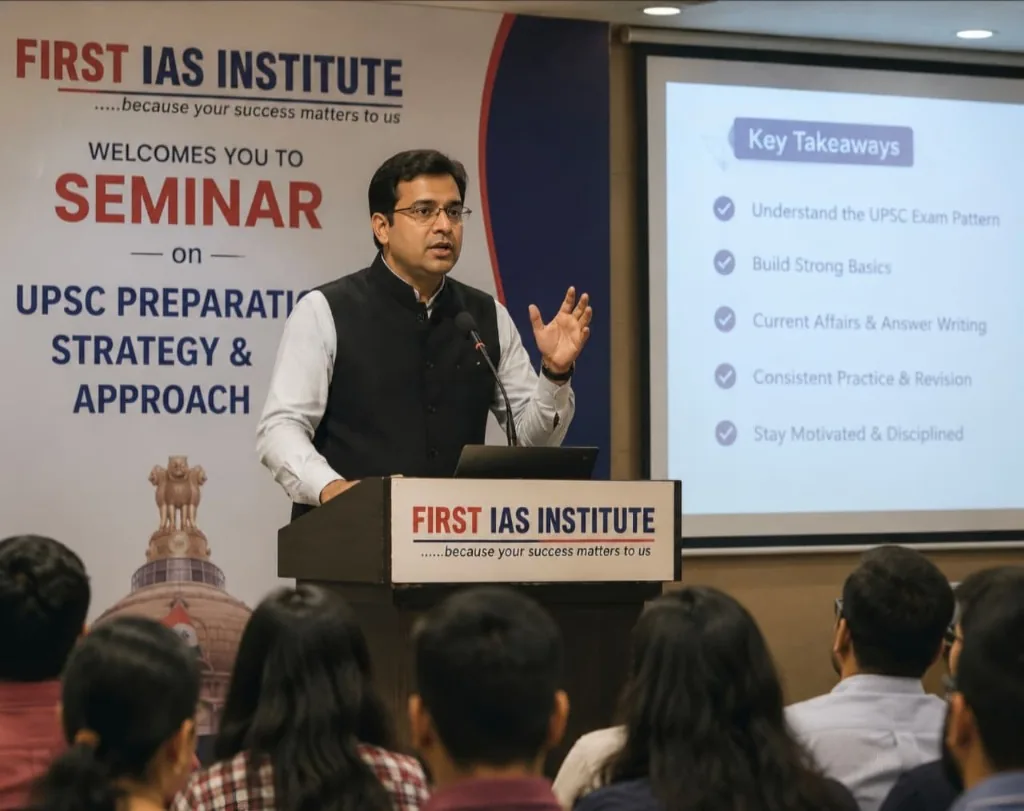
Seminar on “How to Crack UPSC Civil Services Exam”
A focused mentoring session by Ahuja Sir, Mentor at FIRST IAS INSTITUTE, on what actually works in UPSC CSE — from syllabus mapping to answer writing and revision.
Mentor: Ahuja Sir
Institute: FIRST IAS INSTITUTE (Delhi — Hauz Khas & Gurgaon — Sector 14)
Theme: How to crack UPSC Civil Services Examination with a clear strategy
Ahuja Sir at the FIRST IAS INSTITUTE seminar — Key Takeaways on how to crack UPSC CSE
What this seminar covered
Ahuja Sir opened the session by reminding aspirants that UPSC is not cracked by collecting more books or watching more videos. It is cracked by understanding the exam, building unshakeable basics, linking current affairs to the syllabus, writing answers every week, revising limited sources again and again, and staying disciplined for 12–18 months.
The presentation slide titled Key Takeaways listed five pillars. Below is a full recap of what Sir explained under each point — and how you should apply it in daily preparation.
Key takeaways — what Ahuja Sir told aspirants
These five points were the core of the seminar. Treat them as a checklist, not slogans.
1 Understand the UPSC Exam Pattern
Sir stressed that many serious students still study “topics” without knowing where those topics appear in the paper. Before opening any book, map the full Civil Services Examination:
Prelims: General Studies Paper I (merit) and CSAT Paper II (qualifying). Prelims is elimination — accuracy, PYQs and revision matter more than covering extra material.
Mains: Nine papers including Essay, four General Studies papers, two Optional papers, and two qualifying language papers. Mains rewards structured writing, examples, and syllabus coverage — not mugging.
Personality Test: The interview checks clarity, honesty, awareness and administrative temperament. It is not a quiz of current affairs headlines.
His instruction: keep the official UPSC syllabus on your study table. If a newspaper article or YouTube lecture cannot be tagged to a syllabus line, do not spend hours on it. Pattern-first study stops random reading and saves attempts.
2 Build Strong Basics
Ahuja Sir was clear: current affairs without concepts is noise. Foundation must come from NCERTs and then a limited set of standard books — not ten sources for the same chapter.
Polity: Constitution, Parliament, federalism, rights, and governance — understand articles and principles, then add current examples.
History: Timeline + causes and consequences. Modern India for Prelims weightage; art, culture and world history as the syllabus demands for Mains.
Geography: Physical processes, Indian geography, maps and resources. Diagrams help both memory and Mains answers.
Economy: Basic macro concepts (GDP, inflation, fiscal/monetary policy, budget) before schemes and newspaper numbers.
Environment & Science: Ecology fundamentals, biodiversity, climate, and applied science from current developments.
Sir’s method: finish basics first. Only then layer current affairs, government reports and answer enrichment. Students who jump to “advanced notes” without NCERT-level clarity keep repeating the same mistakes in mocks.
3 Current Affairs & Answer Writing
These two were taught together because UPSC does not ask “news.” It asks issues — with a static core and a contemporary angle.
Newspaper with a purpose: Read for polity, economy, IR, environment, social issues and science that map to GS papers. Make short notes tagged to syllabus headings, not a diary of the entire paper.
Monthly compilation is a revision tool, not a substitute for understanding. Link every issue to a static topic (e.g. a new bill → legislative process + federalism).
Answer writing is non-negotiable for Mains. Sir asked students to practise introduction–body–conclusion, use headings, data, maps/diagrams where relevant, and finish within time.
Previous year questions (PYQs) show the examiner’s language. Write PYQs before inventing your own questions.
Evaluation: Unchecked answers do not improve. Get copies assessed, note repeating errors (vague intros, no examples, poor conclusion) and correct them in the next test.
His line to the hall: Prelims is about elimination; Mains is about expression. If you only read and never write, you are preparing for half the exam.
4 Consistent Practice & Revision
Sir warned against the “new source” addiction. Rankers revise the same notes multiple times; average aspirants keep switching PDFs.
Limited sources, multiple revisions: One standard book per subject + class notes + current affairs file. Revise in cycles (weekly micro-revision, monthly full revision).
Prelims mocks: Sit full-length tests, analyse every wrong and guessed question, and maintain an error notebook.
CSAT cannot be ignored. Qualifying paper still ends thousands of attempts. Practise comprehension, basic numeracy and reasoning on a fixed weekly slot.
Optional + GS together: Do not park optional for “after Prelims” if you are in a full-cycle plan. Optional can decide the final rank.
Essay & Ethics: Regular practice with examples from administration, society and personal observation — not last-month cramming.
Practice without analysis is wasted time. After every mock, Sir said, spend as much time on the answer key and your mistakes as you spent on the paper itself.
5 Stay Motivated & Disciplined
UPSC is a long exam. Motivation fluctuates; discipline should not. Ahuja Sir treated this as a strategy point, not a pep talk.
Fixed timetable: Same wake-up, same study blocks, same weekly test day. Protect 6–8 focused hours rather than 14 distracted hours.
Small, accountable groups: FIRST IAS INSTITUTE keeps limited batch size (around 35) so mentors can track attendance, tests and writing — unlike halls of 150–200 students.
Health and breaks: Sleep, short walks and a weekly off prevent burnout. A tired mind cannot recall GS in the exam hall.
One attempt, one plan: Stop comparing your day with social media toppers. Measure yourself against last month’s test scores and coverage.
Mentor contact: When you stall, ask. Doubt sessions exist so you do not lose weeks on the wrong book or the wrong optional.
Sir closed this slide by saying selection is usually the result of ordinary days done consistently — not one heroic month before Prelims.
How to crack UPSC — Sir’s practical roadmap
After the five takeaways, Ahuja Sir walked through a stage-wise plan that beginners and repeaters can follow at FIRST IAS INSTITUTE (classroom in Delhi & Gurgaon, or online).
Stage 1 — Foundation (first 3–4 months)
NCERTs + class notes for GS, CSAT diagnostic, optional shortlisting, and a habit of newspaper-to-syllabus linking. No test-series panic yet — build concepts.
Stage 2 — Prelims integration
MCQ practice, PYQs, full mocks, CSAT weekly drills, and revision of static + current. Cut new sources. Raise accuracy.
Stage 3 — Mains writing cycle
GS + Optional + Essay on a calendar. Evaluated answers, value addition (reports, examples, diagrams), and Ethics case practice.
Stage 4 — Interview readiness
DAF-based questions, current issues, honesty in answers, and mock interviews. Personality Test is a conversation, not a lecture.
Crack formula in one line from the seminar: Syllabus + limited sources + writing + revision + mentorship. Skip any one, and the attempt becomes a lottery.
Mistakes Sir asked students to stop immediately
Reading three newspapers but writing zero answers in a week.
Collecting coaching PDFs instead of finishing and revising one standard book.
Ignoring CSAT until two weeks before Prelims.
Choosing optional by “what friends took” instead of interest, overlap with GS, and availability of guidance.
Studying 14 hours with phone notifications on — then calling it hard work.
Skipping mock analysis because the score felt bad. Low scores are data, not a verdict.
How FIRST IAS INSTITUTE supports this strategy
The seminar was not only theory. Sir connected every takeaway to how the institute actually runs classes:
Small batches so faculty can check writing and doubts — not a microphone lecture to 200 students.
Integrated Prelims + Mains + CSAT + Interview so current affairs, tests and answer writing sit inside the core programme.
Printed study material and NCERT-based teaching to protect the “strong basics” rule.
Centres: Delhi (Hauz Khas) and Gurgaon (Sector 14), plus online live/recorded options for working aspirants.
Mentorship: Ahuja Sir and the faculty team track consistency — the fifth takeaway — not only syllabus coverage.
If you want this same roadmap as a guided classroom or online batch, speak with counselling for 1-year, 2-year or 3-year UPSC CSE programmes.
Join the next batch / ask Ahuja Sir’s team
Counselling for course details, batch timings, fees and admission after this seminar recap.